EXECUTIVE COMMITTEE
Bossey, Switzerland
17-20 February 2009
Document No. 12
“In the very place where Jesus Christ walked upon the earth, walls now separate families and the children of God - Christian, Muslim and Jew - are imprisoned in a deepening cycle of violence, humiliation and despair.”
Amman Call, WCC International Peace Conference,
June 2007, Jordan
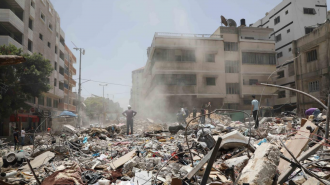
1. The Gaza war during Christmas season took a terrible toll on lives and communities that were already fragile. Bombs, missiles and rockets striking densely populated areas spread an unconscionable sorrow from Gaza to much of the world. Approximately 1400 Palestinians are dead – mostly civilians, children and women – thousands more are wounded, countless thousands are traumatized, and there remains widespread destruction and damage to homes and institutions including church clinics and a hospital. Four civilians are dead in neighboring Israel and 11 soldiers were killed during the fighting and many other people injured.
2. The humanitarian situation in Gaza remains extremely alarming. More than one million people, 80 percent of the population, depend on food aid. Thousands of jobs have been lost. The educational and health systems have broken down due to the blockade that is still being imposed by the Israeli government. Palestinian church leaders, representatives from Action by Churches Together International and other humanitarian aid workers have been denied access to Gaza.
3. Still violence continues and the word peace is rarely spoken. With concerned people in many countries, we speak now to mourn the dead and to cry out with the wounded. The war and the political decisions behind it have deepened an intolerable spiral of despair, violence and deaths.
4. All the lives lost are sacred. Civilians were trapped in the war zone and had no way to escape. All of us who are part of the international community failed in our obligation to stop the killings. Governments failed to fulfill their legal obligations to prevent or remedy the Gaza war under the terms of international law and international humanitarian law. Such failure discredits international law and gives encouragement to those who rely on the use of force.
5. The Gaza war brought people onto the streets in cities around the world while those responsible for the enforcement of international law stood by doing little to nothing. Israel, like any other state, has the right of self defense, but is also bound by humanitarian principles of proportionality and distinction. The imperative to protect human lives is mandatory for all parties involved – including the international community. All have failed in this responsibility. Civilians have suffered on both sides. However, as the United Nations Special Rapporteur for Human Rights noted, “the scale of civilian harm resulting from Israeli unlawful conduct was far greater than that of Palestinian unlawful conduct.” Furthermore, given the evidence of possible war crimes, the international community has a “responsibility to protect” the population at grave risk in Gaza because the government responsible for them has failed to do so.
6. What happened in Gaza is not an isolated tragedy. It is to be seen in the context of the illegal occupation of Palestinian territory that began in 1967. In the case of Gaza the last three years have seen siege and collective punishment harden into a stringent 18-month blockade. Without an end to the occupation, the cycle of violence continues.
7. Israel’s future, its well-being and security depend on a just and genuine peace. The same is true for any prospective Palestinian state. Failure to achieve a just and peaceful resolution of the conflict will open the future to more violence and war. Indeed, while world attention was focused on Gaza, the expansion of settlements and violence against Palestinians continued in the rest of Occupied Palestinian Territory.
8. Gaza’s suffering should serve as a reminder to governments to carry out their third state responsibility. International law requires states not to knowingly aid or assist another state in internationally unlawful acts and not to recognize such acts as lawful. They bear indirect responsibility if they assist or recognize such acts, for example, the illegal use of force and violations of laws and rights that take place daily in Gaza, the West Bank and East Jerusalem.
9. Palestinians who take up arms are also accountable under the law for their use of force. We join the international condemnation of the violence perpetrated by members of Hamas and other groups against civilians in Israel and against their own people.
10. Palestinian unity is essential not only for ending the occupation but also for eventually building a viable Palestinian state. Members of the international community bear partial responsibility for policies that divided people and political structures in the Occupied Palestinian Territory. It is incumbent on the international community now to actively and responsibly support the reintegration of Palestinian political processes including elections and the reunification of Gaza, the West Bank and East Jerusalem.
11. We extend our solidarity to all Palestinians and Israelis who engage in the peaceful pursuit of national Palestinian independence and non-violent resistance to foreign occupation. Non-violent resistance is a right of people living under occupation. We encourage people of all nationalities, religions and good will to support the non-violent struggle for a comprehensive and just peace.
12. We recall the many WCC policy statements that bear on present challenges, including those addressing the siege of Gaza (2008), the Amman Call to churches (2007), the need to engage with all the elected representatives of the Palestinian people (2006), assessing Israel’s pullback from Gaza and ending economic ties to the occupation (2005), plus regular condemnation of all attacks against civilians and consistent church support for the implementation of UN resolutions as the basis for peace.
Accordingly, the executive committee of the World Council of Churches, meeting in Bossey, Switzerland, 16-20 February 2009;
A. Commends the many churches, related ministries, international church organizations, regional and national councils of churches, and civil society groups including Jewish and Muslim organizations that responded to the tragedy in Gaza with prayer, advocacy and aid.
B. Invites greater church engagement in joint efforts for peace, including broader participation in the Ecumenical Accompaniment Programme in Palestine and Israel (EAPPI), in the WCC-led World Week for Peace in Palestine Israel, 4-10 June 2009, and in other initiatives of the Palestine Israel Ecumenical Forum.
C. Calls member churches and related organizations, wherever applicable, to hold their own governments to account for third state responsibilities in the Israel-Palestine conflict under international law.
D. Recommends that member churches and related organizations in a position to do so practice morally responsible investment and purchasing in regard to corporations whose products or services support the occupation of Palestinian territory.
E. Calls for the United Nations to investigate alleged war crimes and other violations of international humanitarian law and human rights law by the parties to the Gaza conflict, including the use of weapons that have indiscriminate effects; and calls for the full implementation of UN Security Council Resolution 1860 which requires inter alia that the government of Israel lift the siege of Gaza.
F. Urges the government of Switzerland as the repository of the Geneva Conventions to convene an international conference of the high contracting parties of the 4th Geneva Convention to investigate armed violations against civilian populations by the parties to the conflict.
G. Supports proposals that churches and governments which funded aid and infrastructure projects in Gaza hold the government of Israel accountable for the destruction it has caused during the war and demand compensation for the same.
H. Calls on the government of Israel to facilitate the on-going work of United Nations agencies in Occupied Palestinian Territory including access for the UN Special Rapporteur for Human Rights to the populations living under occupation; and also calls on the government of Israel to facilitate unimpeded access to Gaza for humanitarian aid workers, rehabilitation and reconstruction teams, pastoral delegations and clergy of religious congregations there.
J. Affirms Palestinian Christians in their endeavors to promote Palestinian unity, be of service to society, minister to their church members and join civil society in peaceful and non-violent measures to bring the occupation to an end.